

At 6:30 in the morning, two hours before her Further Mathematics exam, Rishika Suntharam opened an email from Caltech. It started with one word: “Congratulations.”
She called her mother. They both cried. Then, somehow, Rishika had to put her phone away and sit for her mathematics exam.
That moment would have been remarkable enough on its own. Rishika, 19, from Nilai, Negeri Sembilan, had just been admitted to one of the most selective universities in the world.
But when she talks about the experience now, the acceptance letter isn’t really the part she wants to focus on.
She keeps coming back to a different question: How many Malaysian students could do this too, if they knew the pathway existed?
That question comes from experience.
Learning to Look Beyond the Usual Path
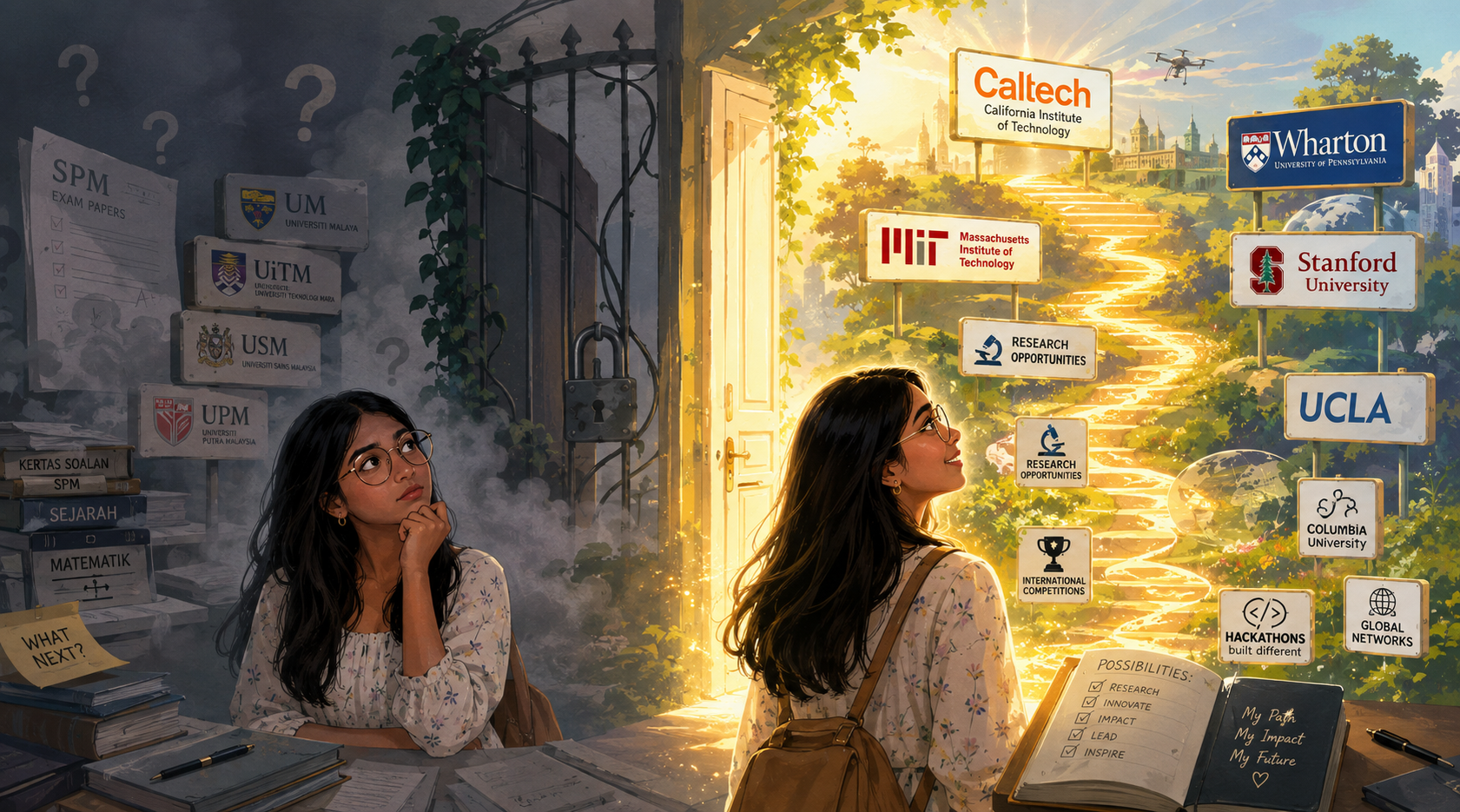
Rishika grew up following a fairly familiar Malaysian academic route: do well in SPM, continue with A-Levels, then apply to university.
What she didn’t have was a clear map for universities like Caltech, MIT or Stanford. She had to discover that world herself.
Her curiosity began much earlier. As a child, she was fascinated by the patterns of the Milky Way. That curiosity eventually took her into mathematics, machine learning and research.
Before applying to Caltech, she conducted 270 experiments on gradient descent and machine-learning optimisation with research mentor Zad Chin. At 18, she presented that work at the 5th International Conference on Mathematical and Scientific Machine Learning in Naples.
None of it came from a neatly packaged programme designed to prepare her for elite universities.
She found the opportunities by looking for them.
She researched scholarships. She found competitions and hackathons. She reached out to mentors. She built a machine-learning project. Gradually, she began piecing together a route that wasn’t really laid out in front of her.
“The biggest challenge was the lack of exposure,” she says.
That lack of exposure almost stopped her from applying to Caltech at all.
“Maybe Me Too”
By the time university offers arrived, Rishika had been admitted to Caltech, UPenn Wharton, Columbia, UCLA and Colorado School of Mines. She had scored 10A+ in her SPM exams and was among the top 20 candidates selected for JPA’s Program Penajaan Nasional. She was also one of seven recipients of the Shell Malaysia Scholarship.
And yet Caltech had once felt almost impossible.
It felt like the kind of university other people applied to — students from different schools, different countries, students who seemed to have access to tutors, mentors and networks that she didn’t.
It took encouragement from people around her to submit the application.
She did. And she got in.
That experience made something click for her. If someone who was already curious, ambitious and doing this much work could nearly convince herself that Caltech wasn’t for her, what about students who had never even heard of the opportunity?
In 2024, while still in school, Rishika co-founded Girls in Numbers to help answer that question.
The organisation runs free webinars and outreach programmes in girls’ schools across Malaysia, introducing students to international universities, scholarships, competitions and other opportunities they may never encounter through the usual academic pathway.
So far, it has reached more than 1,200 girls.
For Rishika, the most meaningful response isn’t necessarily a student saying, “I want to go to Caltech.”
It’s something much smaller.
“Maybe me too.”
She likes that phrase because it isn’t a promise. It doesn’t tell a student that she has to become someone else, or that she will definitely get into an elite university.
It simply gives her permission to imagine that she might.

The Problem Isn’t Talent
There is an easy story to tell about students from countries like Malaysia: that they simply don’t have enough access to the kind of talent or resources found at the world’s top universities.
Rishika sees it differently.
The talent is already there. What is often missing is information, exposure and a sense that these opportunities are actually within reach.
That distinction matters.
A student can’t apply to something she doesn’t know exists. And it’s difficult to build the experiences universities look for when nobody has shown you where to start.
Rishika’s answer isn’t to wait for the education system to change completely. It’s to make the information easier to find — and to make the path feel a little less foreign.
She’s already started.
In September 2026, she will begin studying information and data science with applied and computational mathematics at Caltech, with hopes of pursuing AI research and eventually contributing to projects at NASA’s Jet Propulsion Laboratory.
At the same time, she plans to keep growing Girls in Numbers across Malaysia and, eventually, Southeast Asia.
“Giving back is not something I’ll do after I make it,” she says. “It’s what I’m doing right now.”
That may be the most interesting part of Rishika’s story.
The achievement isn’t only that a girl from Nilai got into Caltech.
It’s that, after finding a road that wasn’t obvious to her, she’s already trying to make it more visible for the girls coming next.